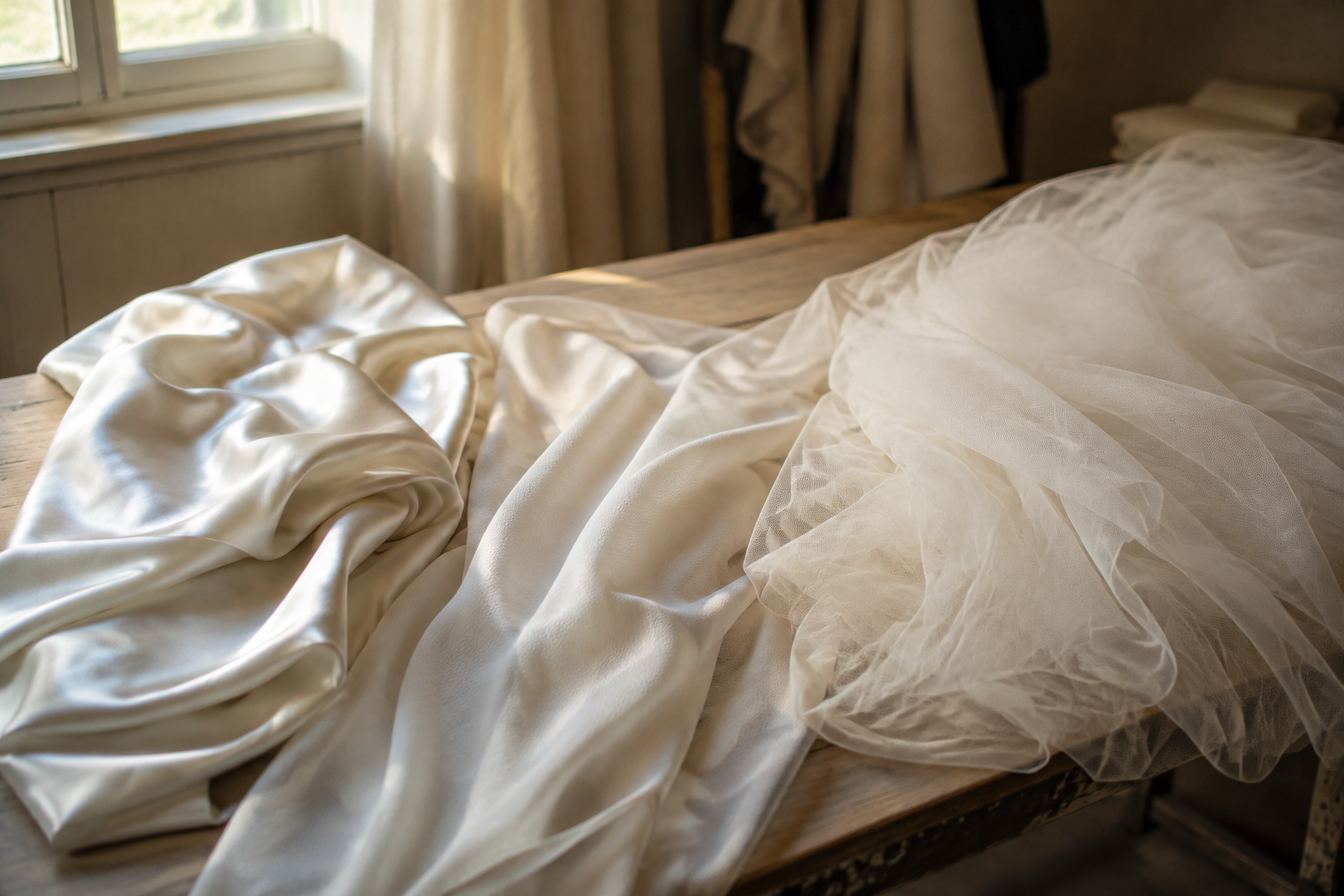
One ivory dress catches a bright ribbon of light. Another keeps its surface quiet. A third turns the space around your legs into a cloud. Before the neckline or the train enters the conversation, fabric has already changed the picture.
Satin, crepe and tulle are useful words to take into a bridal appointment. They are less useful as a ranking. The question is which finished dress gives you the look and experience you want.
Begin with three visual moods
Maggie Sottero’s fabric guide describes satin through its smooth, glossy surface, crepe through a matte finish with texture, and tulle through airy layers. Think of those descriptions as a first set of visual clues. They do not tell you everything about a particular gown.
For your appointment notes, use three ordinary words: shine, line and volume. Which one appears most often in the dresses you have saved? You may discover that the photographs share a surface quality even when their necklines differ.
If you cannot choose, that is useful information too. Ask to try one example of each mood rather than bringing twenty nearly identical reference images.
Look at satin beyond the highlight
When trying a satin gown, turn slowly toward and away from the mirror. Notice where the light travels across the bodice and skirt. Look at a full-length view before moving closer to a fold or seam.
A glossy finish may be exactly the drama you love. The next question is whether you also like the dress in a quieter patch of light. With the salon’s permission, compare a photograph taken in its usual fitting area with one nearer a window. Keep the camera position similar so the comparison tells you something.
Do not reject or choose every satin dress because of one sample. Ask what fabric and lining this style uses, and whether another construction would give you the same visual idea with a different feel.
Let crepe make its own case
A quieter surface puts more of your attention on the outline. Look at where the dress begins to fall away from the body, how the back reads and what happens when you take a normal step.
Try describing what you see without using “flattering” as the whole answer. “I like the uninterrupted line from the waist” tells a stylist more than “this one is better.” So does “I want a little more room when I sit.”
Crepe is not a promise that every dress will stretch or feel the same. Ask about the actual sample in front of you. Your decision belongs to the complete garment, including its lining and support, not a single word on the product page.
Count the experience of tulle, not the layers
Tulle can create the airy, layered impression that draws you toward a fuller skirt. In its fabric-choice guide, Maggie Sottero identifies tulle as netting used in layered bridal looks.
Once you are wearing the sample, look down as well as into the mirror. How much skirt do you want around you? Ask the stylist to show you how to manage it when walking and sitting. Notice whether the volume feels joyful or distracting to you.
Compare the dress with the veil you are considering. Two beautiful pieces can create a different total amount of detail than either does alone. Take one photograph with the veil and one without it before deciding that more layers are the answer.
Use the same comparison for all three
Keep a short note for each favorite: what you love in the mirror, how it feels when you move, and what you still need to ask. Bring the shoes and undergarments the salon recommends, and keep the comparison as consistent as you can.
Ask for the style reference and exact fabric description before leaving. If you return to the dress later, those details are more dependable than remembering it as “the soft ivory one.”
Our guide to how wedding gowns read in photographs offers another way to look at your shortlist. For a train, add the bustle conversation before the final fitting.
The best fabric comparison ends with a specific dress and clear reasons you enjoy wearing it. Let the vocabulary open the appointment, then let the garment answer.