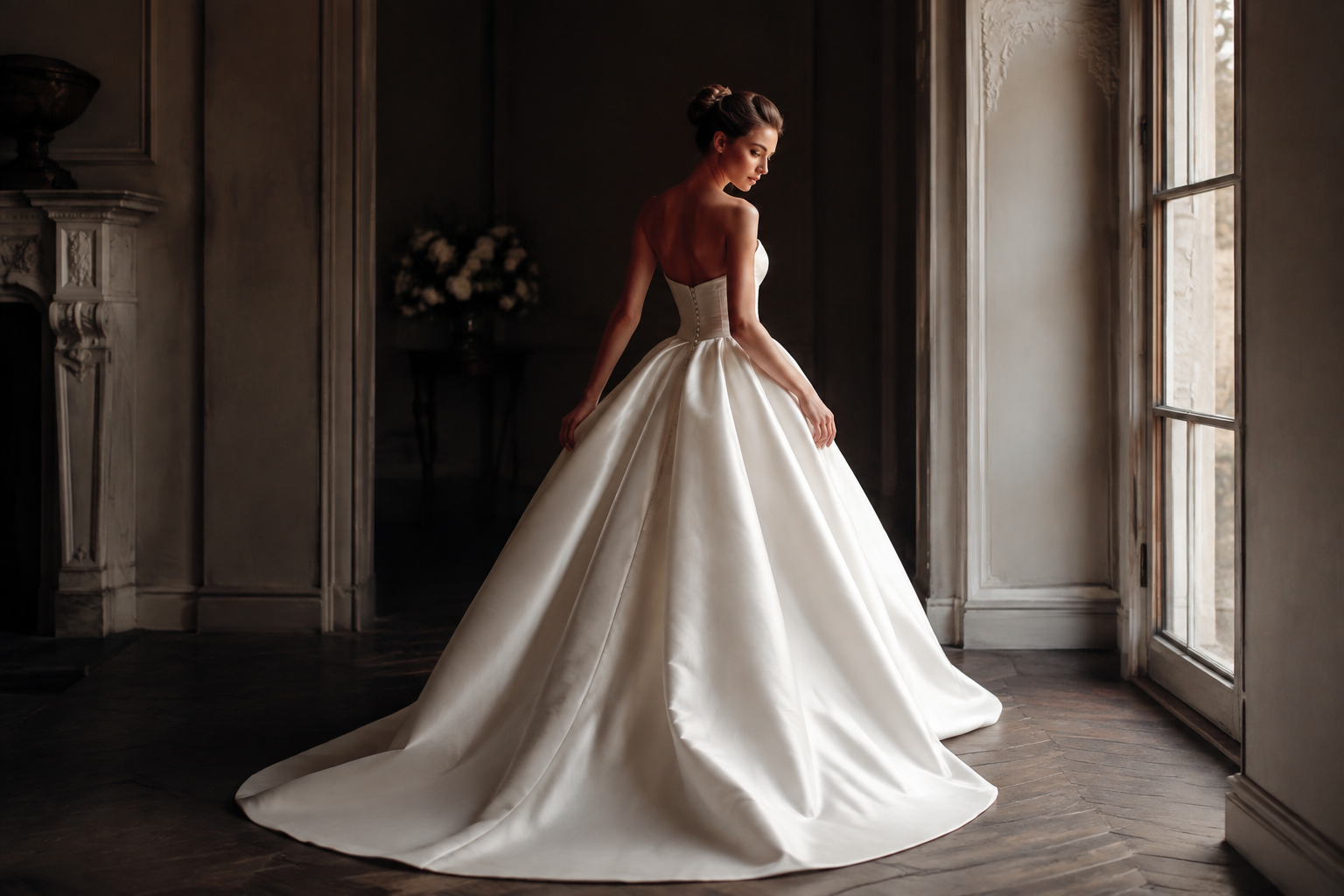
The gown that stopped the room does not always make it into the photographs. You have seen it happen: the try-on video where everyone in the frame goes quiet, the comments agree, the dress is the one. Then the wedding photos get posted and the dress is a white shape. Beautiful woman, lovely light, a dress that could have been any dress.
Nothing went wrong. The gown was simply built for a room and not for a camera, and those are two different jobs. After enough hours comparing product photos, try-on clips and the wedding albums that follow, you start to see the difference before the bride does. This is that difference, taken apart.
Light is the first fabric
Before the cut, before the color, before the price, a gown is a decision about how it will treat light. Every fabric answers that question differently, and the camera is far less forgiving than the eye.
Crepe is matte. It absorbs light instead of throwing it back, which is why a plain crepe column looks so calm in person and so sculptural in a photo: the camera reads the shape of the body, not the surface of the dress. It is also why crepe shows every pin in alterations. There is nowhere to hide.
Mikado and heavy satin have a low sheen that photographs as depth. Folds go dark, high points go bright, and a simple ballgown suddenly has architecture. Under a direct flash, though, that sheen turns to glare across the bodice, and the seams disappear into one hot panel. These gowns want soft light and a photographer who knows to step back.
Tulle is the most honest fabric on camera. It does exactly what it does in the room: it fills space and softens edges. Layered tulle can look enormous in a small fitting room and perfectly proportioned in a wide shot on a lawn. Brides regularly talk themselves out of tulle in the fitting room and regret it in the album.
Lace lives or dies on contrast. Ivory lace over a nude lining photographs as pattern; ivory lace over an ivory lining photographs as texture, which at twenty feet is the same as nothing. If you love a lace gown, ask what it is lined in, and look at it from across the store, not in the three-way mirror.
Glitter tulle, sequins and beadwork are built for the reception, not the ceremony. Under candles and a DJ’s lights they are spectacular. In flat afternoon sun they can read as noise, and under a flash every sequin becomes a small white dot. This is not a reason to avoid them. It is a reason to know what your day actually looks like.
Shape reads at distance, detail reads up close
Most wedding photographs are taken from farther away than a fitting room allows. The ceremony shots, the first dance, the wide portraits: those are twenty, thirty, forty feet. At that distance the camera sees silhouette and almost nothing else.
So the gowns that photograph well tend to have one clean idea. A defined waist. A long unbroken line from the hip to the floor. A neckline with an actual shape, whether that is a straight-across, a deep V or a square. Princess seams that run the full length of the bodice give the camera a road to follow. A row of covered buttons down the back gives the exit shot something to hold on to.
The details you fall for in the mirror, the small appliqués, the tiny pearls at the waist, the delicate straps, survive only in the close portraits. Those photographs matter, but there are five of them, and there are two hundred of everything else. Fall in love with the details, by all means. Just make sure the silhouette underneath them can carry the day on its own.
The dress that everyone remembers in the room is usually about detail. The dress that everyone remembers in the photos is always about line.
White is a problem the camera has
Pure, optic white is the hardest color in photography. It clips: the camera runs out of room to record brightness, and the folds of the dress flatten into a single sheet. Photographers fight this all day long, and they mostly win, but it costs them shadow detail in the dress, which is exactly what makes a gown look expensive.
Ivory, off-white, and the warmer diamond and champagne whites all give the sensor somewhere to go. They also tend to be kinder to skin, and they do not pick a fight with a white ceremony wall or a bright sky. If a bride is set on stark white, I ask her where the ceremony is. Outdoors in summer, pure white is a hard road. Inside a dark church, it glows.
Movement is what the good stills are made of
Look at the wedding photographs you love from other people’s weddings. Almost none of them are of a bride standing still. She is walking, turning, laughing with the skirt caught mid-swing. The dress is a still image of something moving.
Fabrics that move, chiffon, organza, silk charmeuse, light tulle, give the photographer that gift over and over. Fabrics that hold their shape, mikado, structured satin, heavy lace, give one perfect frame and then stop. Neither is wrong. But a bride who wants those in-between, half-turned pictures should be walking in the dress at her fitting, not standing in it.
The three-light test
This is the practical part, and it is the one thing I would ask any bride to actually do. In the store, before you say yes, put the gown under three different lights:
- The fitting-room light. This is the flattering one. Everyone looks good here. It tells you how the dress will look in the getting-ready photos and not much else.
- A window. Ask to walk toward the front of the store. Daylight is what the ceremony and the portraits will be shot in. This is where lace loses its contrast and where sheen either turns to depth or to glare.
- A phone flash. Have your friend take one flash photo from ten feet away. It is crude, but it is close enough to the reception photographer’s light to show you what glitter, sequins and satin will do at nine o’clock at night.
Then walk. Turn. Sit down in it. Look at those three photos side by side, not the mirror. If the dress survives all three, you are done. If it only survives one, you at least know which part of the day it is dressing you for, and you can decide whether that is enough.
Where this comes from: I do the web and search work for Jan’s Boutique, so I spend my days looking at which gowns sell, which get returned, and which photos brides send back. The fabrics above are the ones that keep moving.
What I have stopped worrying about
I used to think the goal was a gown that looked good everywhere. It is not. A gown that is right for a candlelit reception in December does not need to survive a noon garden ceremony, and a plain crepe column that photographs like a sculpture at four in the afternoon does not need to sparkle on the dance floor. The point of the three-light test is not to find a dress that passes all three. It is to know, before the deposit, which light you are buying it for.
The brides who seem happiest with their albums are rarely the ones who bought the most dress. They are the ones who bought the dress that matched the light they actually got married in. Which, when you think about it, is a fairly cinematic way to shop.