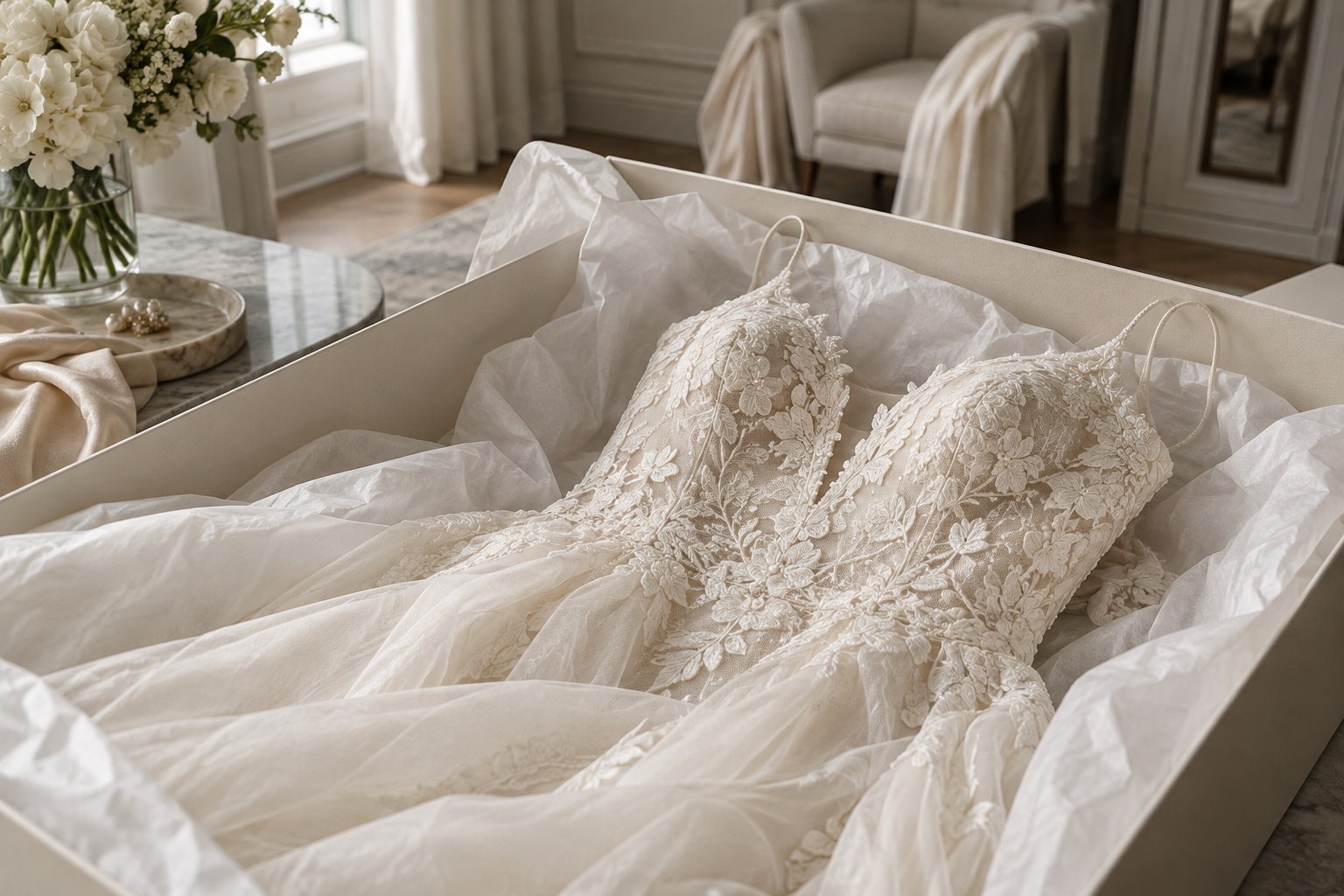
Original conceptual illustration; not an exact retail product.
Your wedding dress needs a place to live between appointments and the ceremony. Decide how it should be supported, where it will be kept and who will move it. The right arrangement depends on the actual gown, including its weight, fabric and decoration.
Ask the salon or maker for instructions before choosing a hanger or storage box. Bring those instructions home with the gown. A storage photograph can be inspiration, but it cannot tell you how to support a particular bodice, sleeve or embellished skirt.
Start with the support method
David’s Bridal’s pre-wedding storage guide distinguishes hanging from laying a gown flat according to its construction and weight. It discusses using hanging loops for suitable gowns and supporting folds with tissue when boxing others. Treat that as a reason to ask which method applies to yours, rather than deciding from a fabric name alone.
Have the salon show you the approved support points. If you are unsure whether a ribbon is a hanging loop or a decorative detail, ask. Do not experiment by putting the gown’s full weight on a delicate strap.
Compare the locations available
David’s Bridal recommends a cool, dry, dark space away from heat, moisture and household traffic. Use that guidance to compare your actual rooms. A spare wardrobe may be practical; a crowded cupboard that must be opened repeatedly may not be. Ask about a different arrangement if your home cannot provide a suitable place.
Measure the available space before buying a container. Make sure the gown can remain in the configuration the salon recommends without being squeezed under other items. Keep food, drinks, cosmetics and household supplies away from the storage area.
| Decision | Record the gown-specific answer |
|---|---|
| Support | Hang or lay flat; approved support points: ______ |
| Cover or box | Recommended material, size and packing method: ______ |
| Location | Room and clear space reserved: ______ |
| Accessories | Separate support or container for veil, cape and jewelry: ______ |
| Movement | Who moves the gown and when: ______ |
| Questions | Salon contact and advice still needed: ______ |
Keep accessories from becoming extra weight
Ask how to store a cape, veil, detachable sleeves or sash separately. Do not use the gown’s hanger as an improvised rack for bags of shoes and jewelry. Keep the matching pieces identifiable, while following their own storage requirements.
If a fitting changes the support arrangement—for example, after a component is removed—ask for updated instructions. The useful record is the current gown’s plan, not the plan for the sample you tried months earlier.
Plan the next handoff
Write the next fitting date and who will collect and return the dress. Before moving it, clear the route and prepare the vehicle or carrying space. Tell anyone helping which parts can support weight. Keep the instructions with the storage container so the next person does not have to guess.
When the gown returns from a fitting, check it with the professional before putting it away. Our dress pickup checklist covers the handoff; our garment-care planning guide explains why last-minute treatment should follow the actual instructions.
Finish with one sentence: “Until ______, this gown stays ______, supported by ______, and only ______ will move it.” A clear arrangement is more useful than opening the bag every day to check whether the dress still looks beautiful.
Sources and scope
Primary sources checked October 16, 2026. The worksheet and styling comparisons are Beau Morante editorial guidance; they are not personal product tests.