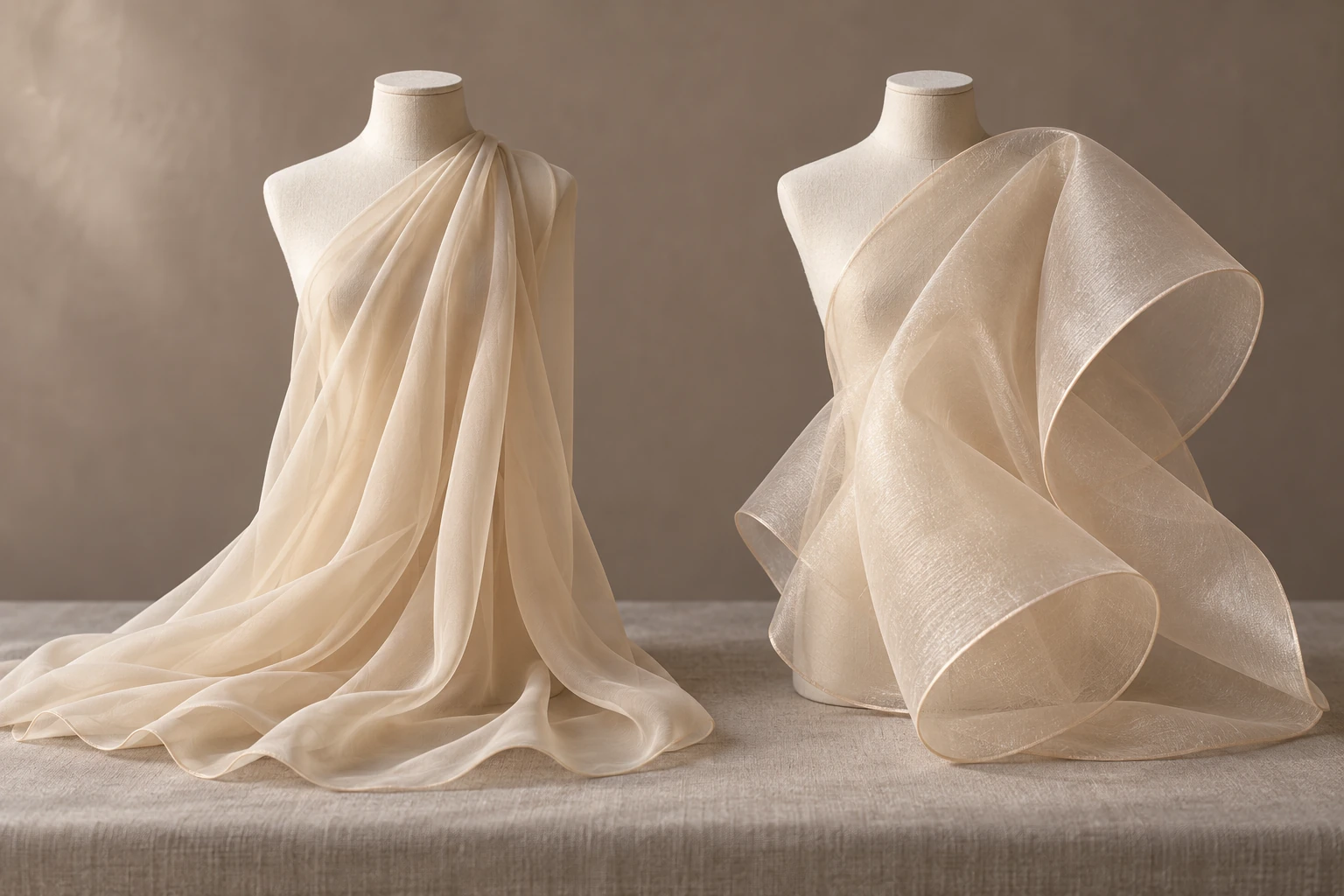
If you want a sheer fabric that falls softly, chiffon may be a useful starting point. If you want sheer volume that holds a more sculptural shape, try organza. Those are typical design tendencies; the finished dress still needs its own assessment.
Mood Fabrics describes chiffon as a sheer plain weave with fluid drape, and organza as a lightweight plain weave with a crisper, stiffer drape. Both names can apply to fabrics made from different fibers. “Chiffon” and “organza” do not mean “silk,” and neither name is a quality ranking.
Compare the effect you want
| Starting point | Typical visual direction | Check on the actual garment |
|---|---|---|
| Chiffon | Fluid folds and soft movement | How the layers fall, what shows through and how the lining moves. |
| Organza | Crisp volume and more defined shapes | How the folds hold, where the volume sits and what happens when you sit. |
Imagine two hypothetical skirts in the same color: one that follows your movement in soft folds, another that keeps a fuller outline. Either could be the look you want. Do not turn that preference into a claim that one fabric is universally cooler, stronger or easier to wear.
Read construction and fiber as separate facts
Ask for the composition of the outer fabric and lining separately, including percentages where supplied. Then ask about finish, layers and garment construction. A single sheer sample cannot represent every part of a lined gown.
The jacquard fabric guide makes the same distinction between a fabric description and its fiber content. For a wider bridal comparison, our satin, crepe and tulle guide looks at surface, line and volume in the complete gown.
Make a useful swatch comparison
With the seller’s permission, view each sample over the intended lining, not an unrelated tabletop. Label which is which and keep the lighting similar. Look at a single layer and the proposed layered arrangement if both can be shown. Record what you observe rather than assuming the final dress will behave exactly like a loose swatch.
Then try the actual garment where possible. Walk, turn and sit normally within the fitting rules. Notice the skirt, sleeves and neckline as separate areas: you may enjoy structured volume in one place and softer movement in another.
Use this fabric comparison card
| Question | Sample or garment A | Sample or garment B |
|---|---|---|
| Movement in the complete outfit | ________ | ________ |
| Transparency over the intended lining | ________ | ________ |
| Shape while standing and seated | ________ | ________ |
| Outer and lining fiber labels | ________ | ________ |
| Care question and who will answer | ________ | ________ |
Record the exact style and sample version with the card. If you are considering a different lining or layer arrangement, ask the maker or seller to confirm what changes rather than treating it as a cosmetic substitution.
Choose between the actual outfits once those questions are answered. The fabric name helps organize the appointment; your preferred shape, the complete construction and garment-specific care requirements finish the decision.
Original editorial planning guidance. Sources and linked guides checked October 21, 2026. The illustration shows a styling concept, not an exact product or a documented event.