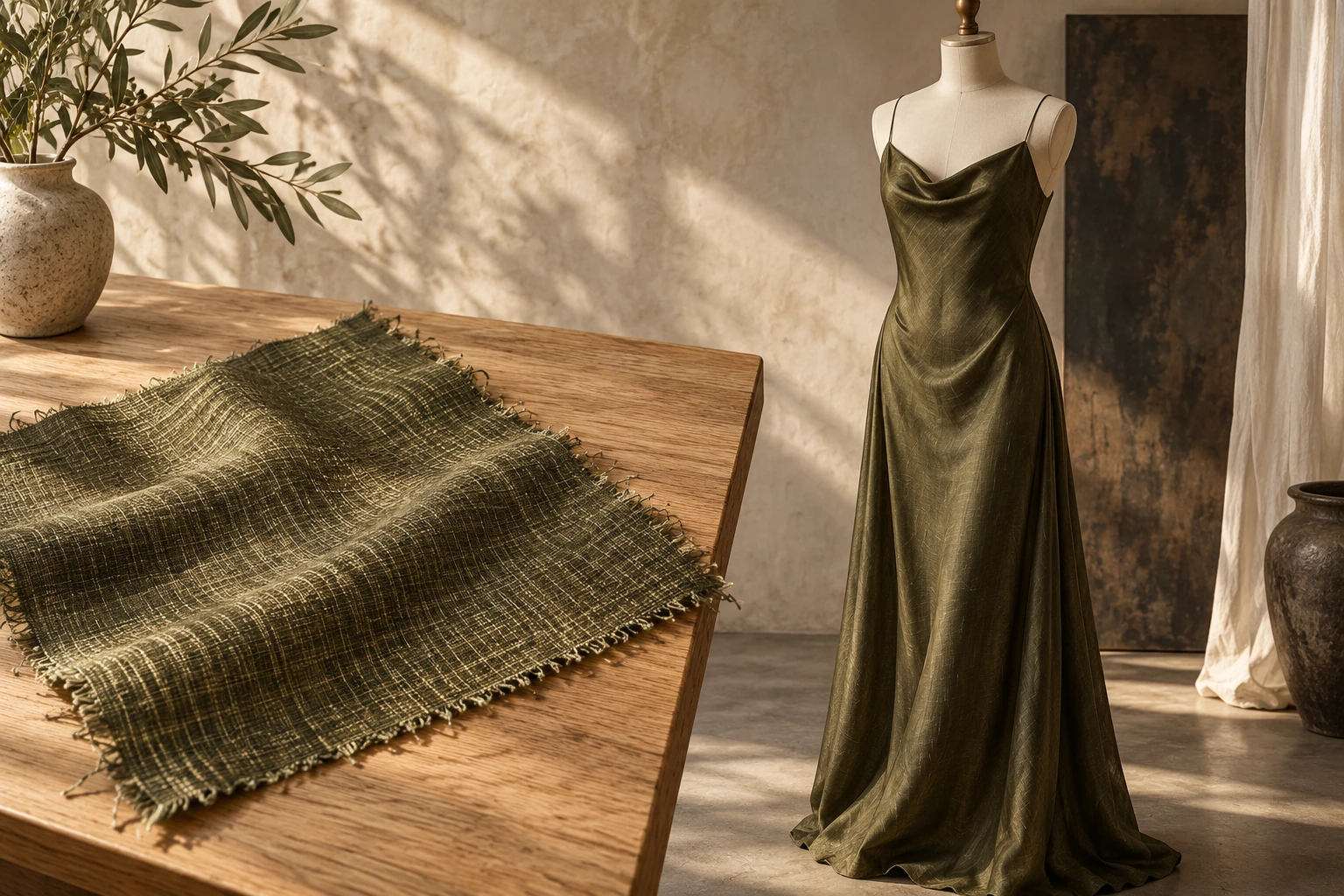
Editorial styling illustration; not an exact retail product or a documented event.
“Bias cut” tells you something about how fabric is positioned in a garment. It does not supply the fiber content, size choice or lining specification. When you shop, use the term as a reason to look carefully at the drape—not a promise that the dress will stretch to fit.
Keep four descriptions separate
In woven fabric, bias runs diagonally to the lengthwise and crosswise threads; true bias is at 45 degrees. Sewing educator Dresspatternmaking explains the grain relationship. The diagonal direction can behave differently from the straight grain, but it does not establish a useful amount of stretch for every finished garment.
| Description | What to record |
|---|---|
| Cut direction | Which garment sections the maker describes as bias-cut. |
| Fiber content | The actual label’s composition, including any elastane. |
| Fabric structure and surface | The maker’s fabric description, checked separately from fiber. |
| Construction | Lining, seams, closures and intended fit of this dress. |
For a concrete example, Seamwork’s Grace pattern is described as a bias-cut slip dress, with a fully lined bodice and recommended woven fabrics. That pattern shows why the words “bias cut” alone do not identify a fiber or establish whether a garment is lined. Both sources were checked October 20, 2026; Grace is a construction example, not a specification for another dress.
Begin with the maker’s size guidance
Compare the size chart and any garment measurements with the maker’s explanation of intended ease. Keep body measurements and finished-garment measurements distinct. If the description is incomplete, ask what fit the design is meant to have and how the size recommendation was reached.
Do not size down simply because the listing says bias-cut. If a sample feels too tight or will not close normally, stop and ask for another size or a fitter’s assessment. Future stretching is not a fit plan.
Use this try-on record
| Record | Your notes |
|---|---|
| Maker, style, size and full fabric composition | ________________ |
| Maker’s intended fit / ease guidance | ________________ |
| Neckline position when standing and sitting | ________________ |
| Seams: where they fall and any pulling or twisting observed | ________________ |
| Lining: coverage, movement and separate fit questions | ________________ |
| Normal step, sitting and reaching observations | ________________ |
| Underlayers and shoes used for this comparison | ________________ |
| Garment measurements supplied and their meaning | ________________ |
| Alterations question requiring a specialist | ________________ |
| Care instructions supplied for this exact garment | ________________ |
Look at the dress after ordinary movement without repeatedly tugging it into place. Record an observation—“the side seam moved toward the front”—rather than diagnosing the cause. The fitter can assess the actual garment and explain whether a different size or change is appropriate.
Choose the drape you want to live with
A close, flowing outline may be the point of one design; another may allow more space. Ask yourself whether you like the actual result in the mirror and while moving, rather than whether it matches an idea of how a bias dress ought to fit.
The illustration here is a styling concept, not a cutting layout or sewing pattern. Follow the maker’s care and handling instructions and seek garment-specific advice about hemming; no universal hanging or DIY alteration timetable is implied.
Once the fit decision is settled, our slip-dress styling guide can help with layers and accessories. For a separate discussion of surface and structure, see the satin, crepe and tulle comparison.