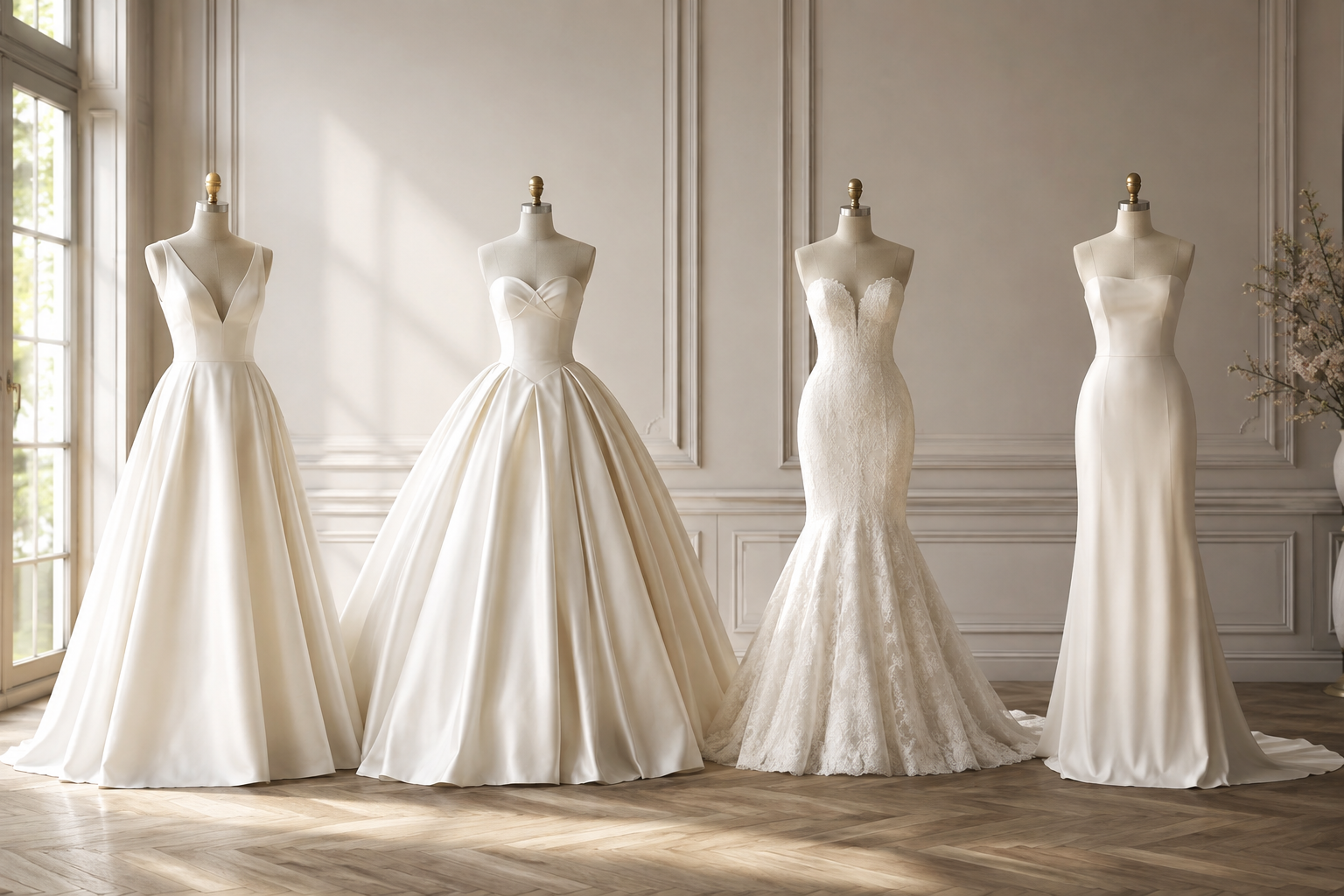
THE BELLE EDIT / THE LOOK
An imagined bridal try-on, with a practical way to compare wedding dress silhouettes.
She could name every dress in her saved folder. A-line. Ballgown. Mermaid. The words had become familiar, but they had not told her which skirt she wanted around her legs. At the salon, a simple ivory A-line waited beside a much fuller gown. She finally had something useful to compare.
Start with three observations: where the skirt opens, how much space it takes up, and what the finished dress feels like when you move. Then separate the outline from the fabric, seams and sample fit. You are choosing a garment you want to wear; no body-shape label has to choose it for you.
CHAPTER 01
She Looked at Where the Skirt Began.
Instead of deciding whether the first dress was “her style,” she asked the stylist to show her where its fitted shape became a fuller skirt. She followed that change in the mirror, from the front and then the side.
The basic vocabulary is useful here. An A-line widens gradually; a ballgown carries more skirt volume. A sheath stays comparatively close, while fitted styles open farther down. In Essense of Australia’s silhouette guide, trumpet and mermaid are distinguished partly by where and how the flare begins. Look at the actual gown as well as its category name.
Her first note was ordinary: “I like room around my knees.” It gave the next dress a specific question to answer.
CHAPTER 02
Two Full Skirts Made Different Pictures.
The stylist placed the fuller gown nearby. She looked at the amount of skirt from waist to floor, then at the space around the hem. What appealed to her was not simply “more dress.” She liked the wide outline in one view but preferred the quieter transition of the A-line when she turned.
Compare the entire outline before concentrating on lace or sparkle. Ask where the waist seam sits and what creates the volume underneath. If the stylist shows the gown with an optional underskirt, record that; the same outer dress with a different supporting layer is a different comparison.
She left the ballgown on the shortlist without making it the winner. A beautiful shape could remain interesting while she worked out whether she wanted to manage that much skirt.
CHAPTER 03
The Fabric Was Changing the Answer.
The next A-line looked unlike the first. Its surface caught the light, and its folds appeared more defined. She had nearly blamed the silhouette for a difference she was seeing in the finished construction.
The satin, crepe and tulle comparison gives useful language for shine, surface and volume. Use those words beside the silhouette name rather than treating either as a complete description. Ask about the actual fabric, lining and support in each contender.
She traced a seam with her eyes, then asked which details would remain in the ordered gown. A clip holding the sample in place was part of the try-on, not a promised feature. She kept “what I can see now” separate from “what the correct size still needs to show.”
CHAPTER 04
She Gave the Narrower Skirt Its Own Turn.
A fitted gown came into the room. Before stepping away from the mirror, she asked the stylist what movement was safe in that sample. Then she took her normal step and tried a chair. She did not pull against the fabric to complete an imagined test.
She wanted to notice the dress without turning the comparison into a performance: did she keep adjusting her stride, holding the skirt or worrying about the closure? Those observations belonged beside the style reference. They were questions for the fitter, not proof that every fitted silhouette would behave the same way.
The movement conversation in our fitting guide is written for a mother-of-the-bride outfit, but its useful starting point travels: describe the action and where you feel resistance. Ask what can be assessed in this sample and what cannot.
CHAPTER 05
The Photographs Needed the Same View.
With permission, she took a front and side photograph of the two remaining gowns. She used the same patch of floor and a similar camera height. One picture included the full hem; the other did too. She wanted a comparison she could understand later.
For each dress, she saved the designer and style reference, sample size, shown color, and any added layer. Beneath those facts, she wrote her own response: “love the folds,” “want less volume at the sides,” or “ask about sitting after fitting.”
She did not edit her shape or let a cropped photograph decide the whole gown. Nor did she need to rank herself in the pictures. The useful difference was between two dresses and the experience each offered her.
CHAPTER 06
She Left With One Clear Preference.
The A-line remained on her list. She could now explain why: a gradual opening, enough skirt for the outline she wanted, and a surface she liked in more than one patch of light. The final fit still needed its own appointment.
Before committing, she asked for the specific gown’s availability and an assessment of any proposed changes. Maggie Sottero’s alterations guidance cautions that major reconstruction can demand substantial time and money. An imagined future alteration was not a feature she already had.
She kept her intended shoes and underlayers on the fitting list. Her next step was to resolve the remaining garment questions, with the actual costs and timing recorded before deciding.
FINAL LOOK
She stood once more in the ivory A-line. This time she looked at the dress without searching for the name that would explain her reaction. She could point to the opening of the skirt, the folds she liked and the question still waiting for the fitter. The silhouette had become useful language for her own choice.
SHOP THE STORY
Use these existing pieces before buying anything for the comparison.
- A phone with space for permitted photographs: Keep full-length views and style references together. Make sure both contenders can be viewed at a comparable scale.
- A small notebook or notes app: Record the outline, movement observations and unanswered fitting questions. Keep the sample details separate from the ordered specification.
- Your intended shoes and underlayers: Bring the pieces requested for the fitting. Tell the specialist if either choice remains undecided; a different heel or foundation changes the comparison you are making.
Source review
Linked primary guidance and internal destinations reviewed October 24, 2026. The story is an imagined editorial example, not a customer account or personal product test. Event, retailer and garment-specific instructions govern.
Featured image: conceptual editorial illustration, not a photograph of the events described.