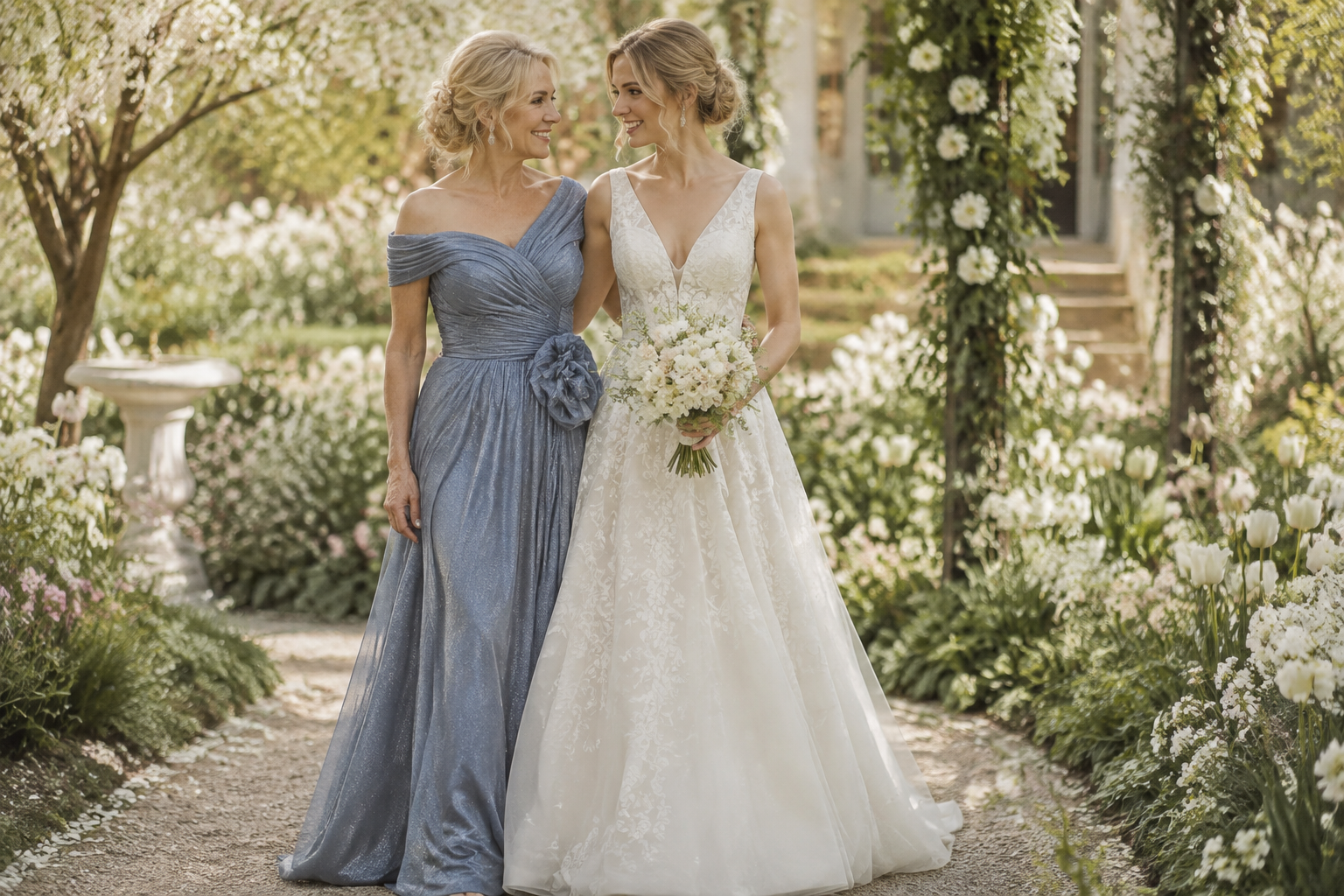
Conflicting mother-of-the-bride dress advice becomes easier to handle when the request is written down precisely. “Please coordinate” might mean the same formality, related colors or an exact match. Those are different requests with different costs. Ask what is meant before changing a plan you already like.
The aim is an agreed outfit decision that respects the wedding’s requirements and the person wearing the clothes. It is not a competition to disappear from photographs or prove who has the right to choose first.
Sort the request before answering it
Emily Post’s advice for mothers places attire in the context of the wedding and describes choosing and communicating outfits, including traditional sequencing. Those conventions are useful conversation starters, not proof that this family has adopted every one of them.
For the current disagreement, identify whether you are dealing with a stated ceremony requirement, a host’s preference, a family tradition or an individual styling suggestion. If the category is uncertain, ask the person responsible rather than allowing several relatives’ interpretations to become a rule.
| Request ledger | What to write |
|---|---|
| Exact request and source | The wording, who made it and when |
| Requirement, preference or tradition? | The confirmed category, or the question needed to establish it |
| Wearer impact | Comfort, mobility, coverage preference and desired appearance |
| Cost and deadline impact | Existing order, return conditions, extra purchase or fitting work |
| Resolving question | One question addressed to the person who can settle it |
| Agreed outcome | What changes, what is accepted, and any next confirmation |
Example one: “The mothers should match”
Hypothetical situation: a relative recommends identical colors, while the couple has said only “coordinate.” The wearer likes navy; the other mother prefers green. Record the relative’s suggestion as a preference until the couple clarifies its own request.
A useful question is: “When you say coordinate, do you mean the same level of formality, a shared palette or an exact color?” The possible agreement might be two distinct colors within the event’s palette. Use the shared coordination page to record that result; do not present one resolution as a universal color rule.
Example two: disagreement about sleeves
Hypothetical situation: the wearer prefers a sleeveless dress and is told she should cover her arms. First establish whether this is an actual ceremony requirement or someone’s taste. Avoid debating whether her age or body “allows” the dress.
If coverage is required in the ceremony, ask which period and areas the requirement concerns and explore a workable layer with the wearer. If it is a styling suggestion, the wearer can decline it. Record the outcome and any layer cost, movement question or storage plan. A compromise should be something the wearer can comfortably use.
Example three: a new request after ordering
Hypothetical situation: a different color is requested after a dress has been ordered. Do not promise a cancellation, exchange or dyeing solution. Read the actual seller’s terms and ask what is possible for that order before agreeing to a change.
The resolving question might be: “This order has these confirmed conditions and this deadline. Is the new color a requirement, and what practical option are we agreeing to?” Keep private budget details within the people who need them. A recorded outcome could be accepting the original outfit or considering a specifically confirmed alternative; neither should be assumed in advance.
Close the loop with a plain note
Write: “We agreed ____. The wearer will ____. The remaining question is ____, to be answered by ____ before ____.” Circulate only the information needed to coordinate. The broader mother-of-the-bride dress guide can then support the ordinary shopping steps without reopening the settled conflict.
Substantively revised October 26, 2026: replaced competitive “spotlight” framing and blanket etiquette rules with a request ledger and three clearly hypothetical resolutions. Primary source checked on that date; original publication date retained. Featured illustration is a fictional family scene, not a documented customer event.