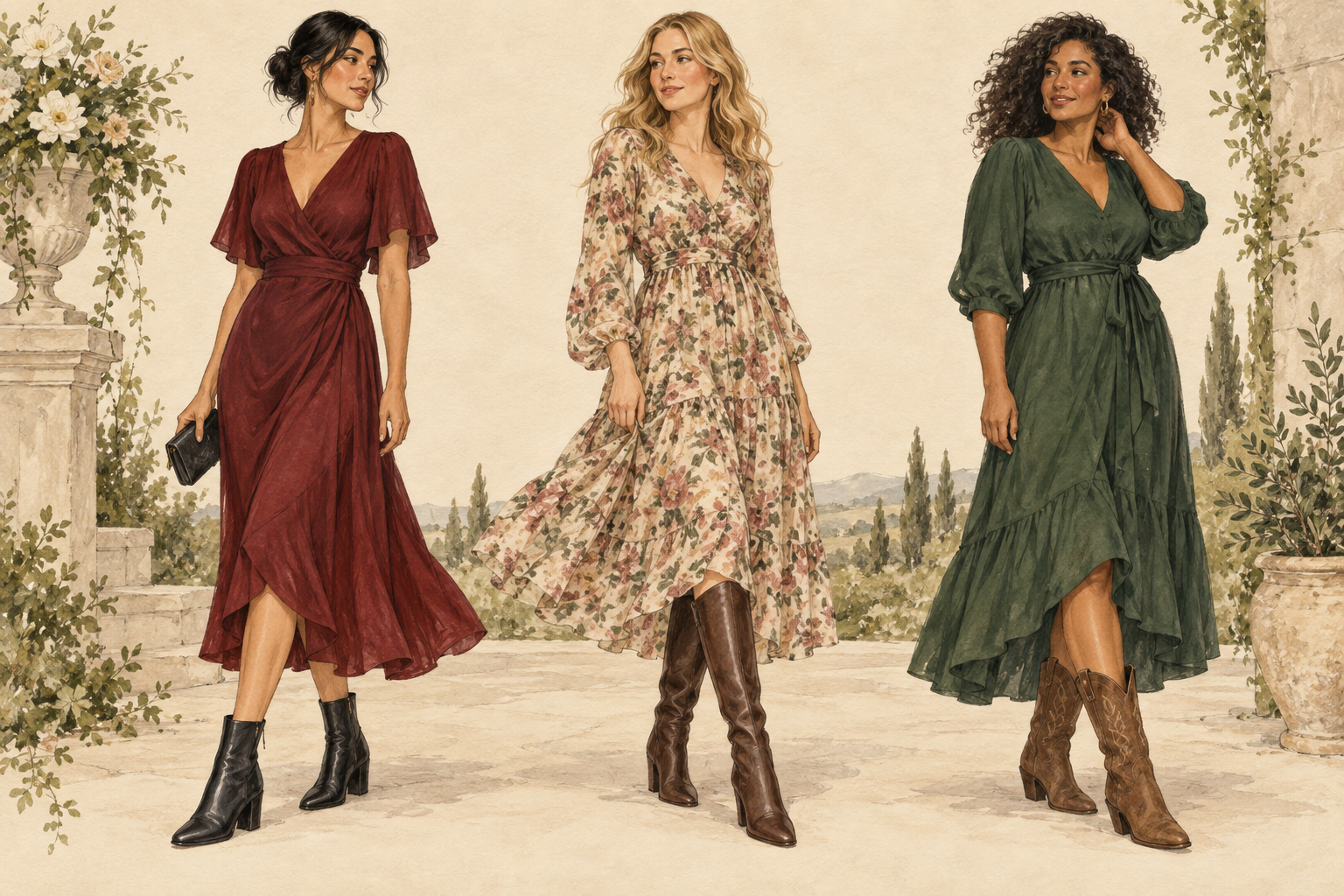
Boots can work with some wedding-guest outfits. Start with the invitation, your actual dress and the walking conditions: a sleek fashion boot, a Western boot and a weather boot are different choices. Try a pair you already own with the complete outfit before deciding whether you need another option.
The useful question is whether this pair works for this celebration. A good mirror view is only the beginning; you also need to sit, walk and move without adjusting your skirt at every step.
The illustrations are conceptual styling studies, not tested outfits or depictions of the linked product.
Read the invitation before choosing the boot
Look for the stated dress code and any guidance on the couple’s wedding website. Emily Post’s wedding-guest attire guidance distinguishes expectations by formality and timing; it does not universally approve boots. Our wedding-guest dress codes guide can help you interpret the wording.
A barn or country venue does not automatically mean Western attire. Equally, a black-tie invitation does not establish a universal ban on every boot, and dressing formally does not require a high heel. Compare the entire outfit with the requested formality. Ask the designated contact only if a genuine uncertainty remains after reading the available guidance.
Compare the boot’s details
Set the boots beside the dress and look at the shaft shape, surface finish, sole thickness and hardware. A plain shaft and restrained detailing offer one possible dressier starting point. Pointed toes and tall heels are optional, not requirements.
Notice how a chunky sole, broad buckle or slouchy shaft changes the outfit’s emphasis. Ankle boots leave more of the lower leg visible; knee-high boots create a longer covered area. Neither is automatically the better choice. Check the actual combination from the front and side.
Check where the hem and boot meet
With ankle boots, inspect the visible space between the shaft and the dress hem. Does the combination look intentional to you when you stand naturally? Try a different dress from your wardrobe if the meeting point distracts you. There is no mandatory number of inches of visible leg.
With knee-high boots under a midi, pay attention to the skirt’s lining as well as its outer fabric. Both should move freely around the shaft. The boot does not have to disappear beneath the dress, and a visible boot top is not automatically a mistake.

Walk, sit, turn and take a normal step up. Look for fabric catching on a zip, buckle or boot top. Sit long enough to notice whether the lining rides up or settles awkwardly. If the dress has a slit, check what it reveals during movement, not just in a still pose.
Repeat the check without holding the skirt in place. If the outfit only works while you arrange it, try another hem-and-shaft combination before the wedding.
Assess foot and calf fit
Use the particular maker’s size and fit guidance. For example, Dolce Vita’s boot-fit guide advises measuring both calves at their widest circumference with the foot flat on the ground. Treat that as the brand’s measuring direction, then consult the guidance for your own pair.
Try the socks or tights you plan to wear. The boot should close without force and allow ordinary movement; check your toes, heel and calf while standing and seated. Do not rely on painful breaking-in, sizing down or home stretching to rescue the fit. For hosiery choices, see tights with a wedding-guest dress.
Separate coverage from weather protection
A closed boot is not automatically waterproof, warm enough or suitable for slippery ground. Check the forecast, the route from transport to ceremony, and the actual product specifications. DuoBoots’ care FAQs, for example, distinguish treated suede from fully waterproof footwear.
Follow your boot’s care directions. A block heel, tread or protective spray cannot guarantee safe footing. If you need travel footwear and a change for the celebration, decide where you will change and where the spare pair will stay.
Three combinations to try from your wardrobe
- Cocktail invitation: a burgundy crepe midi, simple black ankle boots and an existing compact evening bag. Evaluate the hem-and-shaft meeting point.
- Dressy daytime invitation: a patterned midi with plain knee-high boots in a quieter color from the print. Check the seated lining and hem.
- Explicitly Western or relaxed invitation: familiar Western boots with a dress matching the stated formality. The invitation supports the choice; the venue name alone does not.
These are editorial starting points, not tested outfits or universal recommendations. Substitute pieces you own.
Your five final decisions
Confirm the invitation, hem-and-shaft interaction, foot and calf fit, weather and route, and spare-shoe storage if needed. If those checks work, your boots may have a place in the outfit. If they do not, change the combination or reserve the boots for the journey.
An optional finishing detail
The Belle Edit contains affiliate links. As an Amazon Associate I earn from qualifying purchases. Selections are researched, not hands-on tests.
Try your boots with an evening bag you already own before adding another piece. If your outfit still needs a compact bag, compare the Dasein velvet clutch in The Belle Edit with your essentials and preferred way of carrying it.