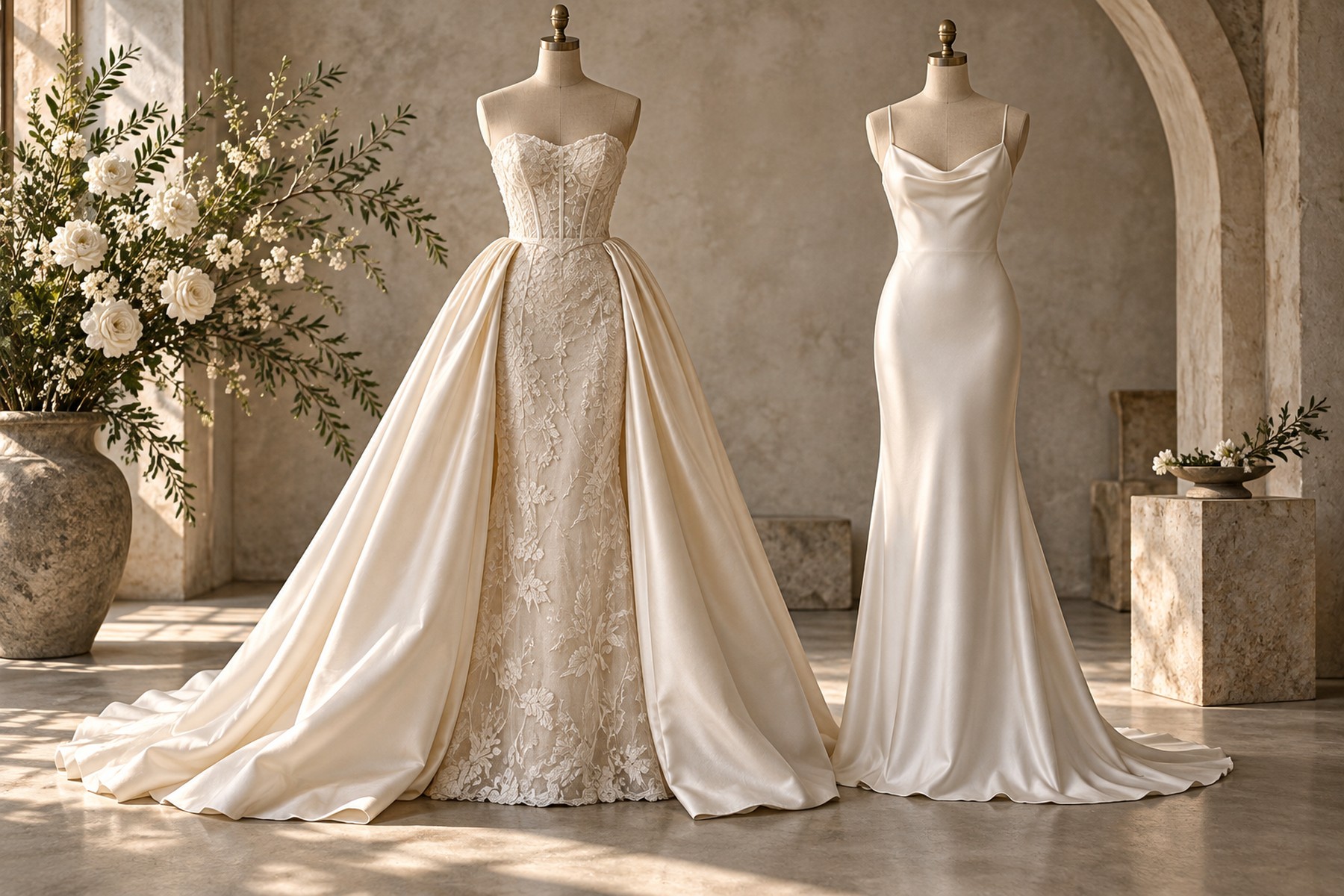
Original conceptual illustration; not an exact retail product.
An overskirt changes one gown; a second dress replaces it. The more useful choice depends on what you want to feel different at the reception and what the day can comfortably accommodate. Begin by naming that change before comparing shopping prices.
If the aim is less skirt volume, ask whether removing the overskirt achieves it. If you want a different bodice, neckline or overall fit, the original gown remains underneath. Keeping one outfit is also a valid option; a second look does not need to be part of the day.
Compare the actual constructions
Ask the maker to show you how the specific overskirt fastens and how the gown looks without it. Karen Willis Holmes describes its Circle Swirl Train as finished on a waistband with a hook-and-eye closure. That product example does not establish the attachment, compatibility or ease of removal of another overskirt. Have the provider assess your combination.
For a second dress, identify which shoes and underlayers it requires. A dress that looks simple may still involve a closure you need help reaching. Do not estimate a changing time from an online photograph.
Use one worksheet for both options
| Decision | Overskirt plan | Second-dress plan |
|---|---|---|
| Reason for changing | What improves when the layer comes off? | What improves when the whole outfit changes? |
| Quoted cost | Piece, attachment work and any gown alterations. | Dress and its own fitting work. |
| Other pieces | Can current shoes and underlayers remain? | Which finishing pieces change too? |
| Changing place | Where can the layer be removed and laid safely? | Is there private space for a complete change? |
| Help | Who understands the actual fastening? | Who helps with closures if wanted? |
| Storage | Named person, suitable container and destination. | Where the first gown and its components go. |
| Timing | Rehearsal at the maker’s recommended stage. | Rehearsal with every piece being changed. |
Compare complete quoted totals
Record the real item price, fitting quote, necessary accessories, delivery and any agreed preparation costs. Keep optional purchases separate. Do not count the same existing shoes twice, and do not assume the overskirt must be cheaper simply because it is one component.
If one alteration is still unassessed, leave a question in the total. Our estimate guide helps distinguish fitting work from a design change. A retailer’s broad range is not a quote for your gown.
Walk through the transition
Imagine leaving the ceremony, reaching the changing space and returning to your guests. Confirm whether the room will actually be accessible then. Name the helper only after asking them, and agree who takes custody of the removed garment. Avoid leaving this responsibility with whoever happens to be nearby.
If you keep a train, review the bustle questions separately. An overskirt decision and a bustle decision can affect the same transition, but they are not interchangeable solutions.
Choose the result you want to wear
Finish with one sentence for each option: “This change gives me ___, and it requires ___.” If the benefit feels small and the transition feels burdensome, keep the outfit you already like. If the change matters, choose the plan whose practical questions you can actually answer.
Sources and scope
Sources checked October 17, 2026. This is an editorial planning tool, not a product test or a guarantee of an individual result.