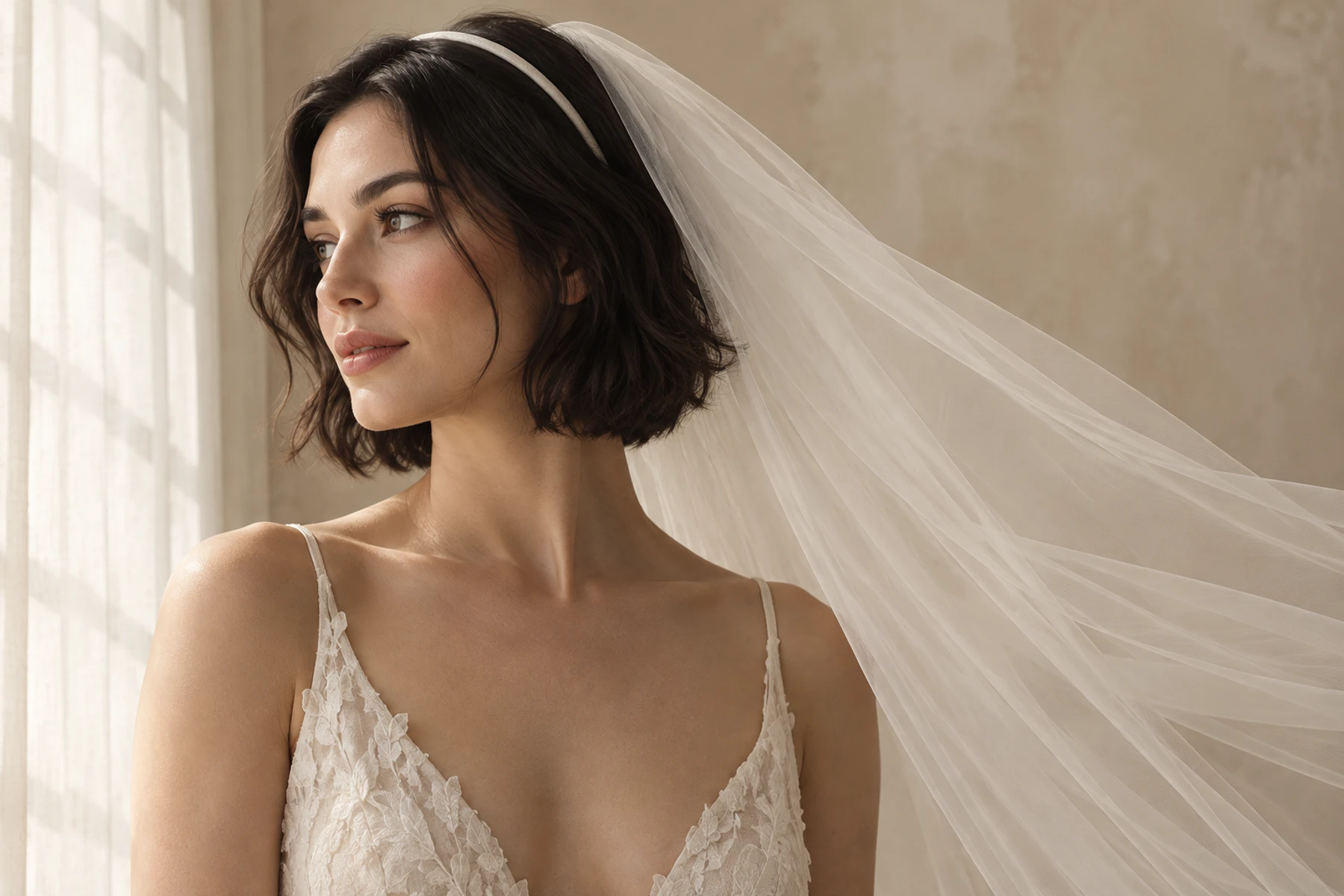
Editorial styling illustration; not an exact retail product.
A pixie, crop or bob can be the starting point for your wedding look. Choose the visual effect you enjoy, then ask your stylist how the actual veil or headpiece could work with your haircut. You do not need to make growing your hair or buying extensions the default plan.
The important decision is the combination: your hair, the exact accessory, its attachment and the way you want to wear it. A photograph of a similar haircut cannot establish that a comb will hold yours.
Bring the actual attachment into the conversation
Save the maker’s exact style and variant, dimensions, stated weight if available, and supplied fastening. If weight or attachment information is absent, ask the maker rather than estimating from a picture. Britten’s veil collection is one place to explore different lengths and types; a collection page is not evidence that every option suits short hair.
Before purchasing, ask whether the stylist needs the piece in hand to assess it. Confirm the seller’s applicable return and alteration terms before ordering for a trial. Do not remove or replace a fastening on the assumption that the change will be easy or reversible.
Three directions to discuss at the trial
- A crop with a light veil. Explore the amount of tulle and the outline you like. Ask the stylist whether a suitable attachment is feasible with your current hair. A lighter-looking veil still needs an actual assessment.
- A bob with a headband-style arrangement. Consider whether you enjoy a visible band with the cut. The stylist and maker should confirm how the veil attaches to that piece; laying a veil over a band in a photograph does not demonstrate a secure method.
- A headpiece without a veil. Try a piece you like, or no accessory. This can be the complete look, rather than a fallback that needs explaining. Check its contact points and comfort too.
These are editorial styling suggestions, not fastening instructions. Tell the stylist if anything pulls or feels uncomfortable, and let them make the adjustment.
Complete one record for each option
| Decision | Record with your stylist |
|---|---|
| Maker, exact style and variant | _____ |
| Length and maker-stated weight, or unknown | _____ |
| Supplied fastening | _____ |
| Stylist’s proposed attachment | _____ |
| What must be checked in person | _____ |
| Comfort during agreed trial movements | _____ |
| Who removes it and when | _____ |
| What remains visible after removal | _____ |
| Unresolved question / follow-up date | _____ |
Plan both versions of the look
Look at the front, sides and back with the veil in place, then with it removed by the stylist. Decide whether you like the remaining shape and any visible accessory. A second piece is optional; the haircut itself may be the detail you want to keep.
Use the hair-trial preparation checklist for what to bring, and the veil-removal handoff guide to agree who learns the exact removal process. Keep the final reference photographs separate from earlier experiments, with permission before sharing them.
Maker collection reviewed October 19, 2026. No specific veil or attachment is recommended as universally suitable.