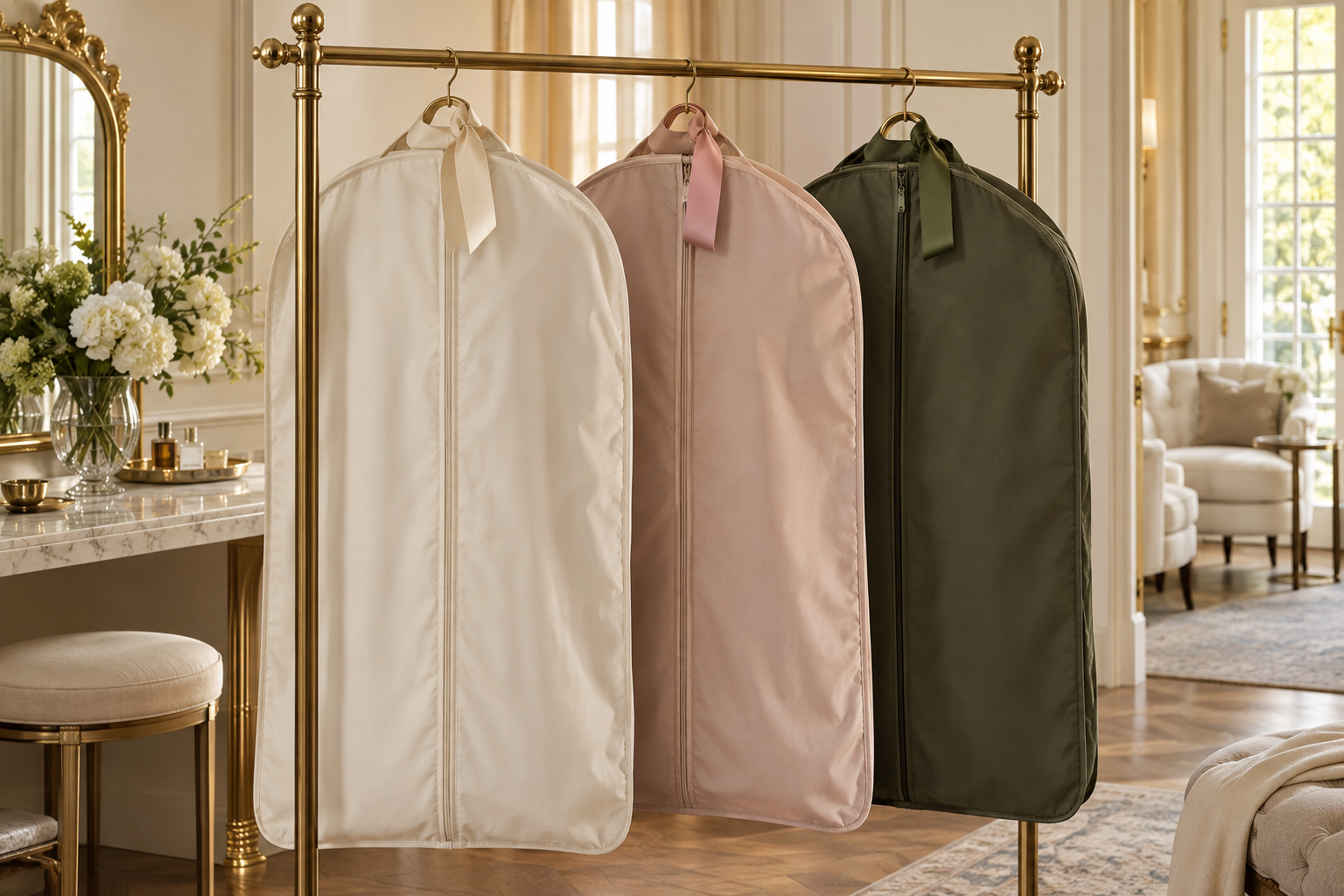
Custom editorial illustration; not an exact retail product.
A getting-ready room can collect several similar garment bags in a few minutes. Later, jackets, spare shoes and accessory pouches may be added to the same corner. Give your own outfit a clear identity before it enters that shared space, so finding it does not involve opening everyone else's bags.
Mark the carrier, not the clothing
Choose a simple, removable identifier for the garment bag handle or another suitable part of the carrier. A distinctive ribbon or a luggage tag you already own may be enough. Make sure it does not obstruct the bag's closure or damage the carrier. Do not attach an adhesive label, pin or improvised marker directly to a delicate garment.
Use only the identifying information needed for the situation. A first name or agreed group label may work better than displaying a home address or full travel details. If the bag has a removable hanger, check that your identifier will stay with the carrier when the garment is taken out.
Give accessories the same simple system
Keep the accessories that belong to one outfit together in a suitable container, following their care instructions. If several people have similar shoe bags or pouches, give yours a matching identifier. This is about recognizing ownership, not fitting every item into one garment bag regardless of construction.
Tell a helper which items are yours if they will be collecting the outfit later. A private photograph of the complete group can be useful, especially when someone is handing over belongings they did not pack. Include any borrowed pieces in your own record so they are not mistaken for communal accessories.
Agree on a place for empty carriers
Once everyone is dressed, empty garment bags can become harder to track than the outfits themselves. Choose a place for yours before removing the clothing. Fold or store it according to its design, and keep any required hanger with it if that is appropriate for the garment.
Ask before moving other people's belongings to create space. In a shared room, one person's tidy pile may be another person's carefully arranged outfit. A clear location agreed by the group is more useful than reorganizing everything without telling anyone.
Treat venue storage as a separate handoff
If a venue accepts garment bags or accessories into storage, follow its own check-in system. Keep any claim ticket where you can retrieve it and confirm when collection is available. Your ribbon or tag helps identify the bag; it does not replace the venue's rules or prove that a particular storage service exists.
Tell the staff or designated helper if someone else will collect your belongings, and confirm what identification or authorization they need. Avoid relying on a vague request to collect the black bag when several people may have brought one.
Check the contents before leaving
At the end of the event, use your short list or photograph to confirm that the correct carrier, outfit pieces and accessories are together. Ask before taking an unfamiliar item that happens to be beside your bag. If something is missing, contact the person responsible for the room or storage area while the arrangement is still clear.
The system does not need special labels or a new organizer. One visible identifier, one agreed storage place and one final contents check can make a shared space easier to navigate without turning another person's belongings into part of your search.