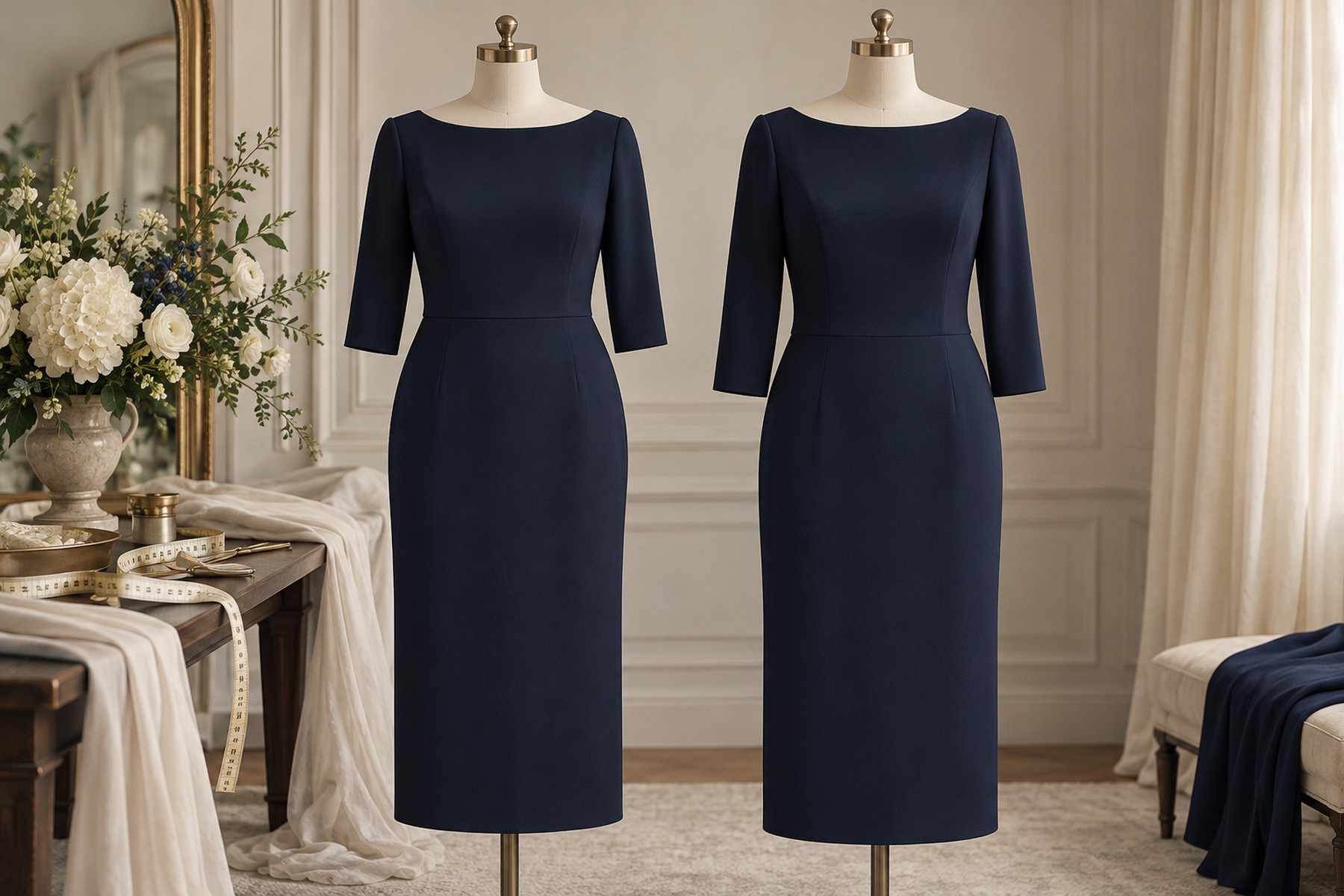
Original conceptual illustration; not an exact retail product.
When a mother-of-the-bride dress is too long, shortening the hem may seem like the whole solution. Before deciding, compare where the bodice and sleeves sit as well. Petite and standard versions can differ in proportions, and the label alone cannot tell you which one you will prefer.
Read the brand’s definition
Macy’s petite-fit guide describes its petite range for frames 5 feet 4 inches and under and discusses changes including shorter torso and sleeve lengths, narrower shoulders and higher armholes. Those are the retailer’s explanations, not a universal specification for every dress carrying a P.
Adrianna Papell’s size guide provides separate petite, standard and plus charts. It also notes that its petite collections can include both true petite sizes and standard midi-length styles described as petite-friendly. Check the actual size designation instead of assuming every dress in a petite shopping collection is cut to petite proportions.
Keep size and proportion separate
Petite does not name a single body size. Use the chart for the exact range and compare current measurements according to the maker’s directions. Do not automatically choose the same number in two ranges or size down to compensate for extra length.
Where possible, compare similar designs in the appropriate sizes. A different neckline, sleeve or fabric can make it difficult to tell whether a preference comes from proportion or from the style itself.
Make this fitting record
| Area | Petite version | Standard version |
|---|---|---|
| Shoulder | Where does the seam or strap sit? | Where does the seam or strap sit? |
| Waist seam | Is its intended position comfortable on you? | Is its intended position comfortable on you? |
| Armhole | What do you notice while resting and reaching? | What do you notice while resting and reaching? |
| Sleeve | Where does the cuff finish, and how does it move? | Where does the cuff finish, and how does it move? |
| Bodice | Any pulling, excess fabric or unwanted shifting? | Any pulling, excess fabric or unwanted shifting? |
| Hem | Length with your intended shoes. | Length with your intended shoes. |
| Work needed | Specific professional assessment and quote. | Specific professional assessment and quote. |
Move before comparing alteration totals
Use the mother-of-the-bride movement checklist with the actual shoes and underlayers. Tell the fitter what you notice without diagnosing the pattern problem yourself. “The waist seam sits lower than I want” is a clearer starting observation than “I must need petite.”
A hem adjustment changes length at the bottom. It does not by itself establish that the shoulder, armhole or waist position will change. Ask a qualified fitter to assess any proposed work on the actual dress and explain what is feasible.
Choose the version with the clearer plan
Keep the item price and written alteration estimate beside each fitting record. Do not assume one range eliminates alterations or always costs less to finish. Mark unanswered work as unknown rather than awarding the option an imagined saving.
Pick the version whose proportions and confirmed finishing plan work for you. Height can help you find a rack to explore; it does not overrule what you experience in the fitting room. This comparison is a shopping tool, not a body-shape rule or a guarantee that a particular cut will fit.
Sources and scope
Sources checked October 17, 2026. This is an editorial planning tool, not a product test or a guarantee of an individual result.