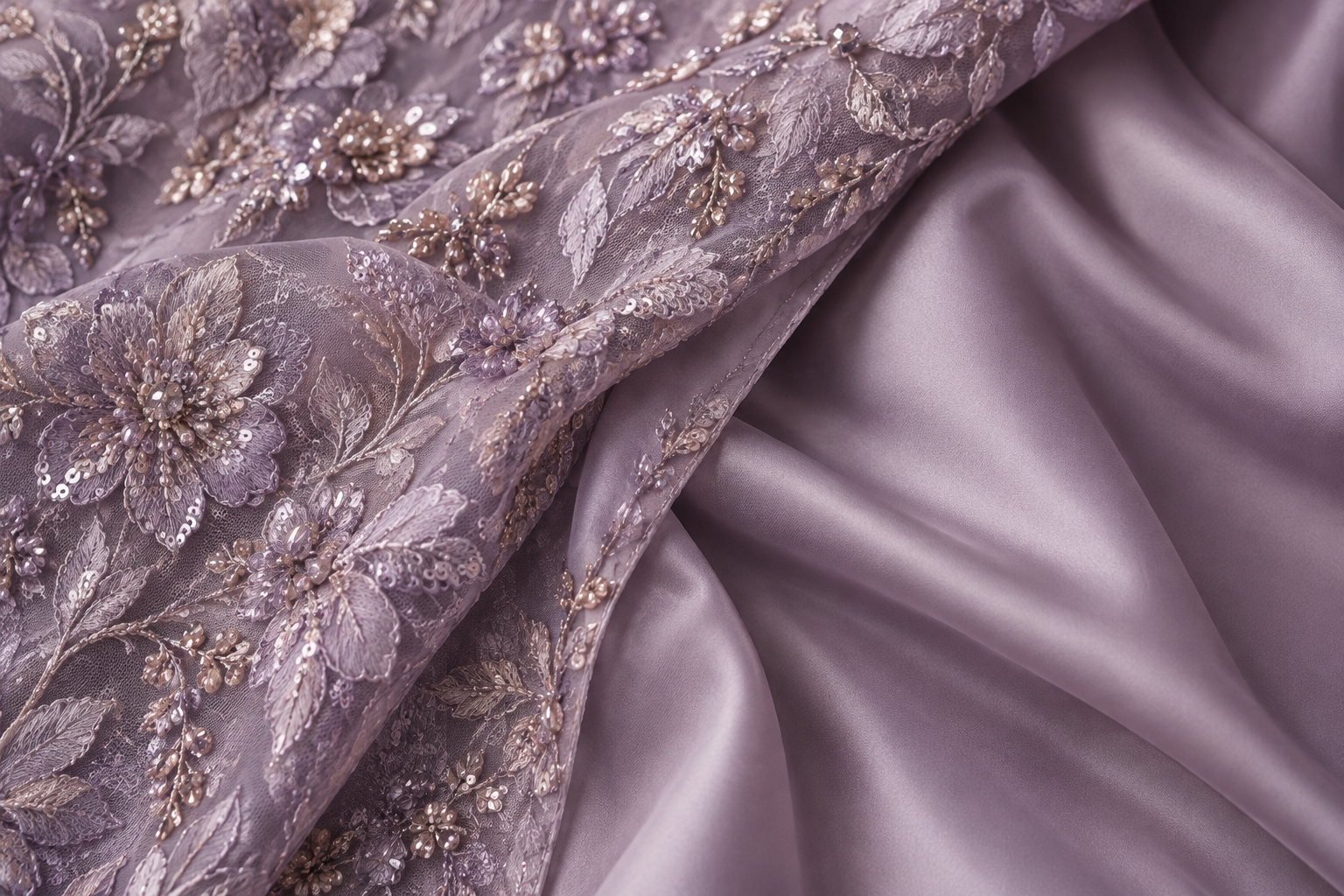
Custom editorial illustration; not an exact retail product.
The outside of a dress can look beautiful while the surfaces you feel are not right for you. Before trying an embellished outfit, tell the stylist which textures and contact points you prefer. You do not need a diagnosis or a long explanation to ask for something that feels comfortable.
Describe a preference in ordinary words
Use examples from clothes you already enjoy: a smooth lining, a neckline that does not brush the neck, or sleeves without a firm edge. Equally, name details you tend to avoid. “I do not like raised texture under my arms” gives the stylist a practical starting point.
Avoid treating a preference as something you should overcome for an event. You can admire beading without wanting it on the dress you wear. A quieter surface, or embellishment in a different area, is a legitimate design choice rather than a compromise in effort.
Ask to see the inside as well as the outside
With the shop’s permission, ask the stylist to show you the lining, neckline finish and inside of the sleeves. Identify where embellishment, seams or fastenings sit relative to your body. Do not turn a delicate garment inside out yourself or pull at decorations to test them.
Ask about the actual materials instead of assuming that a fabric name guarantees a particular feel. David’s Bridal’s April 2026 try-on guidance includes discussing fabrics and textures the shopper dislikes. That supports having the conversation; it does not establish the comfort of a particular dress for you.
Use a short, ordinary try-on
Once the garment is safely fitted, notice the contact points while standing and sitting normally. Tell the stylist promptly if an edge bothers you. There is no benefit in enduring discomfort to complete an arbitrary test, and a few minutes in a shop cannot prove all-day comfort.
If you use particular underlayers, ask whether they can be tried with the dress. Do not assume an added slip or lining will solve the issue. It may affect fit, coverage or warmth, and any proposed change needs assessment on the actual garment.
Compare alternatives by the feature you need
Instead of asking for a completely different style at once, ask for the same broad silhouette with a smoother sleeve, a different neckline finish or less decoration at a contact point. This keeps the part you like while investigating the part that is uncertain.
Write down the exact concern before leaving. If an alteration is suggested, ask who will assess it, whether it is feasible and what it would cost. You can decide against a dress even when someone else finds it comfortable. Your own experience is the relevant information for this choice.
Your next step
Before the next fitting, write down two textures you enjoy and one contact point you want the stylist to check.